

Digital Product Passport Platform
DPP Platform for EU Compliance
GoodsTag helps manufacturers create, manage, sign, publish and maintain Digital Product Passports across all regulated industries.
Trusted by manufacturers and partners






Are you ready for the next product transparency laws?
Your data is scattered across ERP, PLM, and supplier spreadsheets. Regulators will not wait while you reconcile it. One missed disclosure could mean fines, lost shelf space, and shaken consumer trust.

Implementation workflow
From supplier data to a published passport
Collect your data, validate it, link a label, publish the passport and keep it up to date.
Step 1
Collect product and supplier data
Bring in ERP, PLM, PIM, quality and lab data through existing APIs, files and supplier forms.
- ERP, MES and quality systems
- PLM and PIM
- Supplier forms and files
- Lab and test results
Step 2
Validate and approve
Map fields to versioned product-family schemas. Show validation, review, approval and how missing evidence is handled.
- Versioned product-family schemas
- Completeness checks before approval
- Missing evidence flagged for follow-up
Step 3
Pair the label and activate the passport
Factory and logistics workflows associate a pre-printed identifier with a product, batch or item through a scan or system integration.
- Pre-printed QR or data carrier
- Scan or MES pairing
- Activation on the line
Step 4
Publish and control access
Show which information is public and which evidence requires authorised access.
- Public passport view
- Authorised evidence access
- EU Registry TEST registrations; production automated API integration in preparation
Step 5
Maintain and export
Explain updates, version history, export and independent backup using the verified product and commercial terms.
- Updates and version history
- Machine-readable export
- Independent third-party backup
Interoperability
Data carriers and standards, GS1 Digital Link conformant, API-first, multiple identity levels from model to item, and role-based data access.
Compliance controls
Architecture aligned with the passport lifecycle, controlled access and GDPR-compliant processing. Successful EU Registry TEST registrations; production automated API integration in preparation.
Scan a live Digital Product Passport
Experience the Battery DPP.
Experience the Fashion & Textiles DPP for Yourself.
Experience the Detergent DPP for Yourself.

Scan to explore a real, interactive Digital Product Passport.
On the go? [Click here to open the demo]

Scan to explore a real, interactive Digital Product Passport.
On the go? [Click here to open the demo]

Scan to explore a real, interactive Digital Product Passport.
On the go? [Click here to open the demo]
One platform across a multi-product portfolio
GoodsTag DPP Studio holds registered profiles and product-family schemas in one place, so Model, Batch and Item passports stay consistent across your industries.

DPP consulting and implementation
We help your compliance, operations and IT teams determine which requirements apply to your products, identify gaps in data and evidence, and design how passports will be created, activated and maintained. Start with a focused assessment or bring us in for the pilot and rollout.
Industry regulation and compliance assessment
Review product classification, applicable obligations, economic operator responsibilities, identifiers, labelling, required data, access rights and supporting documentation. Review existing evidence and record open interpretation questions. Where the project needs it, GoodsTag can coordinate external legal review.
Outputs: a requirements matrix, evidence checklist and prioritised gap assessment.
Production and systems integration
Review how products are identified, labelled, tested and released. Map existing ERP, MES, product and quality data to passport fields. Define where labels are printed or applied, how they are paired and activated, and who handles exceptions. Describe workshops or a production-site review where relevant.
Outputs: a process map, integration plan and pilot workflow.
Supplier onboarding and data governance
Define what each tier must provide, who owns the request, what evidence is acceptable, and how submissions are reviewed. Cover authenticated declarations, document access, missing-data escalation and change management.
Outputs: an automated supplier collection process via form or import, responsibilities and approval workflow.
Data integrity, access and continuity

Product Identity Management
Issue a unique, standards-ready ID per item (QR/NFC/RFID). GS1 keys (GTIN/lot/serial) or your own. Built to verify.
Digital Twin Foundation
Spin up a live digital twin for every product with lifecycle states, ingredients/materials, and provenance you can trust.


Data Aggregation & Consolidation
Map ERP product masters, batch records and supplier declarations into one passport structure. For example, a bill of materials line, a lab certificate and a supplier material declaration resolve to the same passport fields, with each source retained for review.
Supplier accountability
Collect product performance, material and evidence data across supplier tiers. Use authenticated declarations to document each supplier's responsibility for the data it provides. Where the implementation supports it, the cryptographic record captures the submitting organisation, the data, the timestamp and the version. The responsible operator reviews the evidence and retains its regulatory obligations.


Product Data Analytics & Insights
Track scan behavior, claims usage, and lifecycle KPIs. Spot gaps, prove compliance, and improve the next release.
Industry-specific solutions.
Ready to deploy.
Launch The DemoBattery data, made clear
Understand the EU Battery DPP regulations and how GoodsTag supports compliant, scalable implementation.
Learn about Battery DPP
Fashion compliance, simplified
Understand the EU Digital Product Passport requirements for textiles and how GoodsTag helps fashion brands deploy compliant, scalable DPP infrastructure.
Learn about Fashion DPP
Detergent data, on every shelf
Understand the digital label and product passport of the new EU Detergents Regulation and how GoodsTag turns formulation data into compliant, scannable product information.
Learn about Detergent DPP
Steel data, ready for ESPR
Iron and steel is a priority product group under the ESPR. See what a steel DPP is expected to cover and how GoodsTag prepares your data before the delegated act is adopted.
Learn about Iron & Steel DPP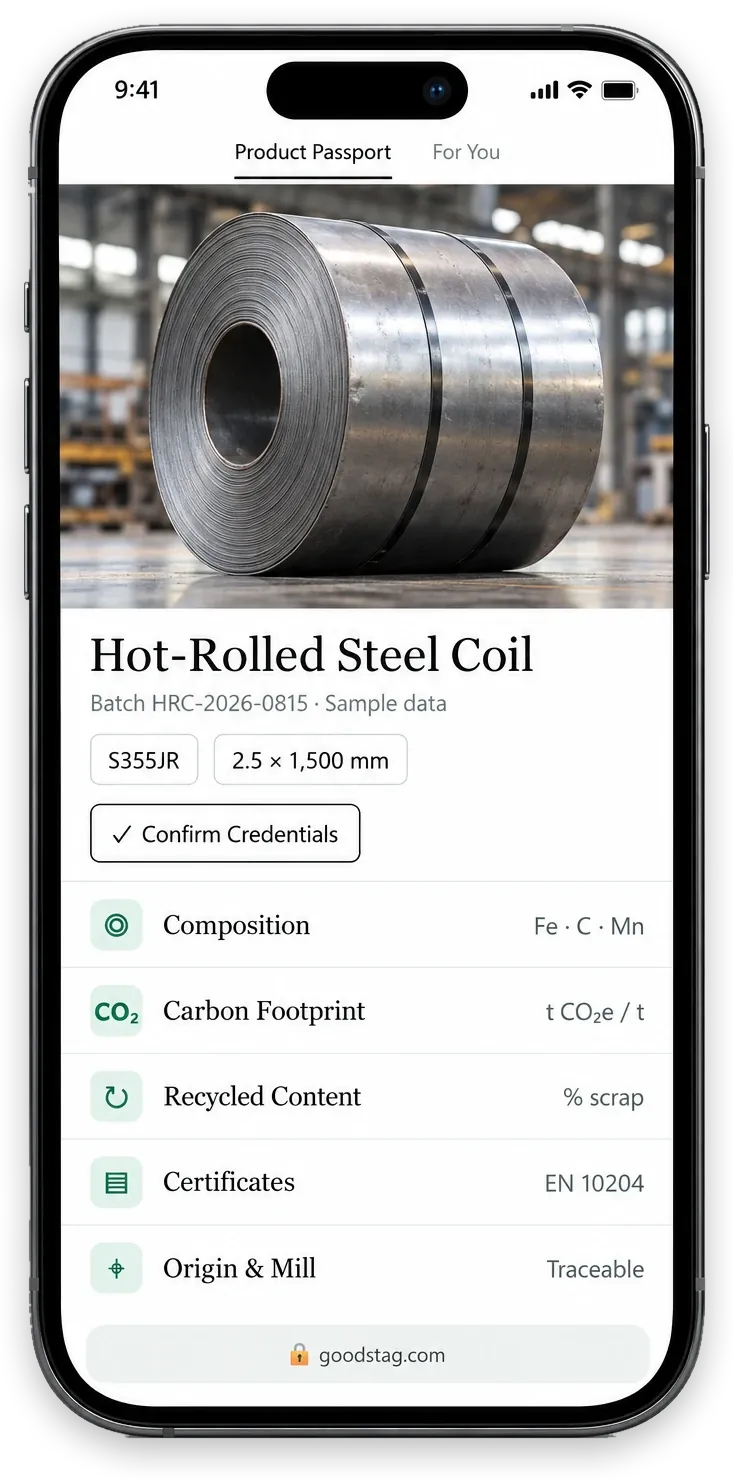
Furniture data, built to last
Furniture is on the ESPR working plan. Learn what a furniture DPP is likely to include and how GoodsTag helps you structure product data today.
Learn about Furniture DPP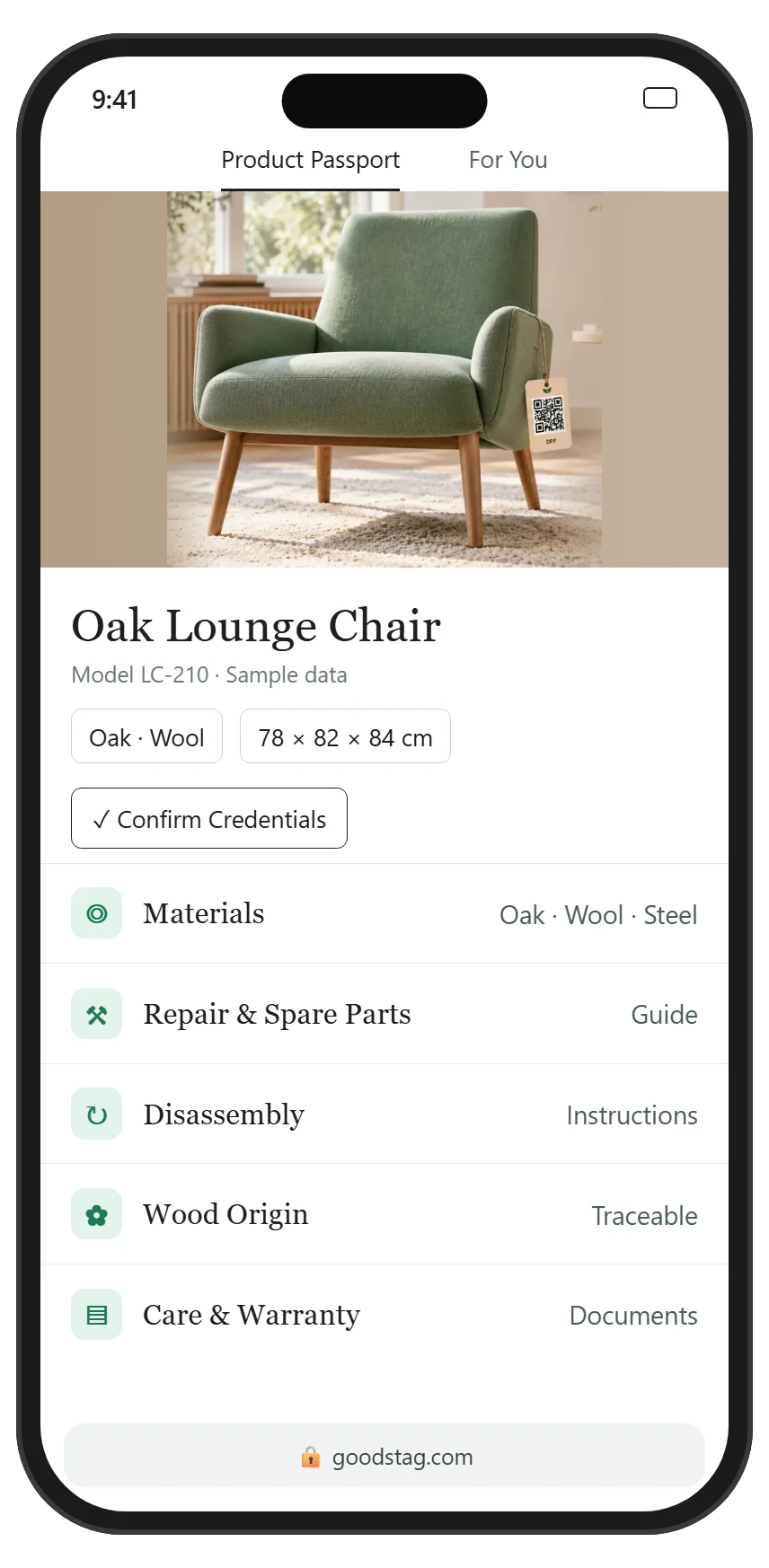
Electronics data, ready to repair
Electronics and electrical equipment are an ESPR priority. See which repair, spare-part, battery and energy-label rules already apply and how GoodsTag prepares your passport data.
Learn about Electronics DPP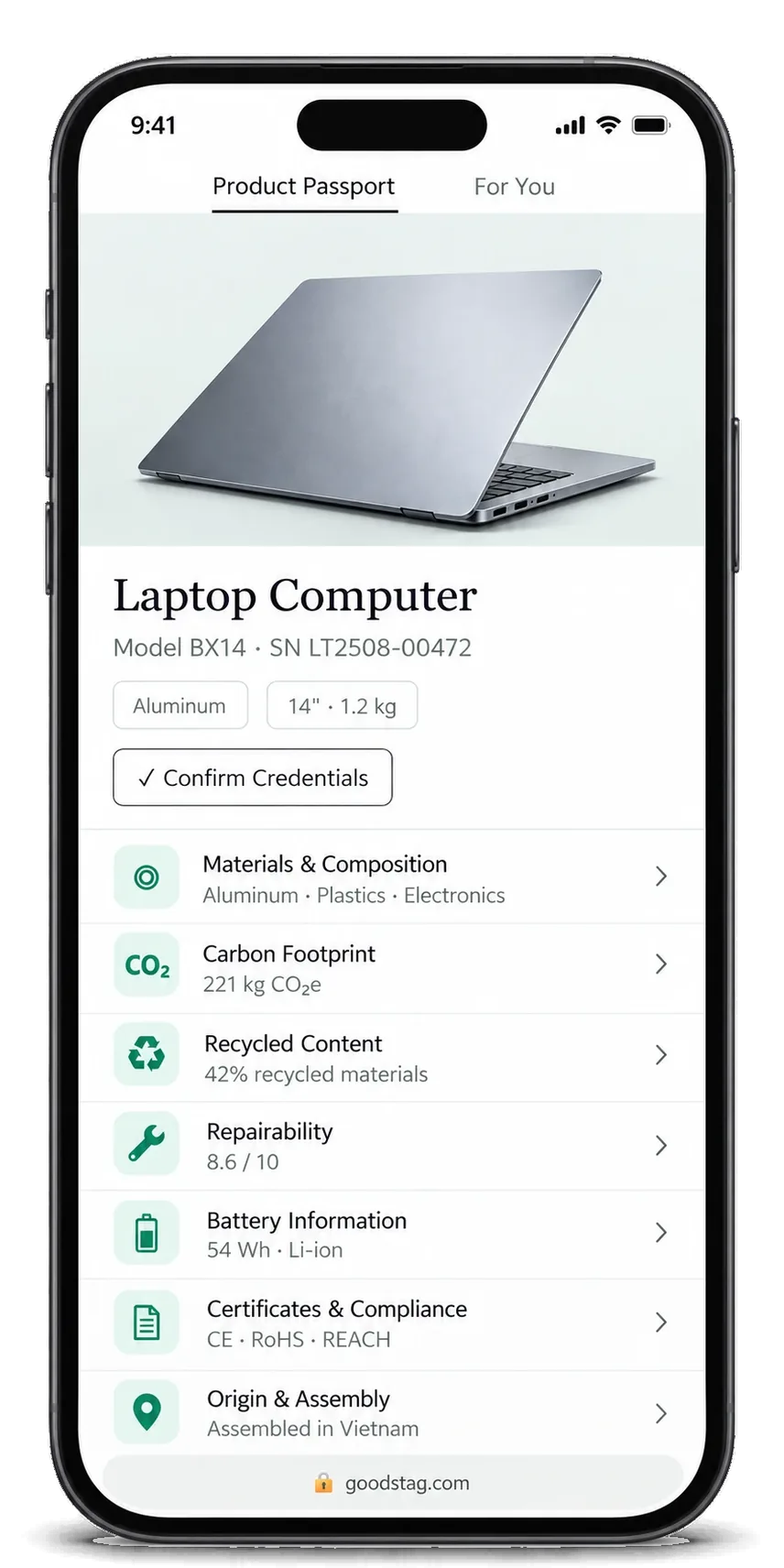
Chemical data, ready to share
Chemicals, paints and lubricants are an ESPR priority. See which CLP, REACH and SCIP rules already apply and how GoodsTag links product and material passports.
Learn about Chemicals DPP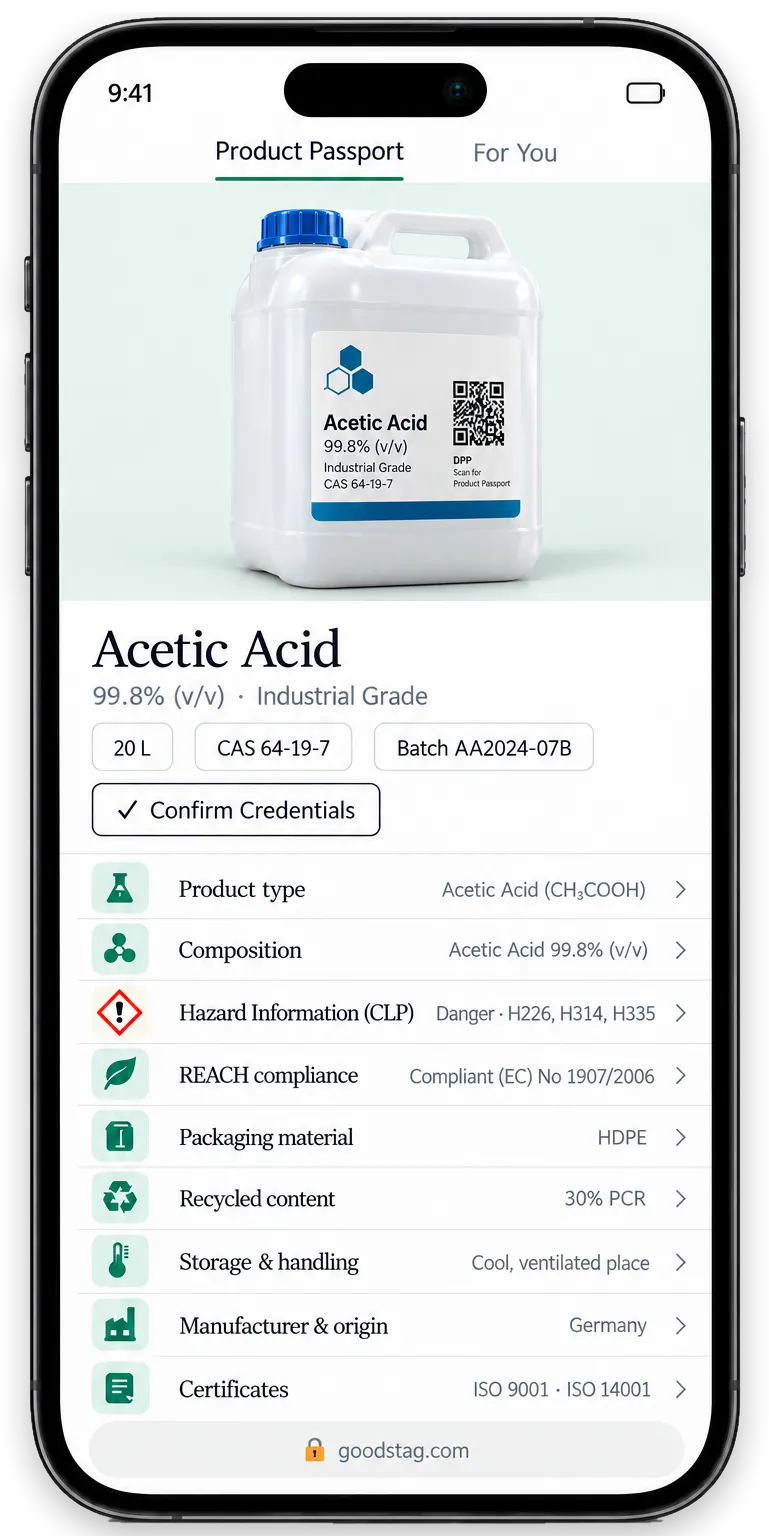
Building data, ready to last
Construction products get their passport from the new Construction Products Regulation. See what it will contain, when it applies and how GoodsTag links product and material passports.
Learn about Construction DPP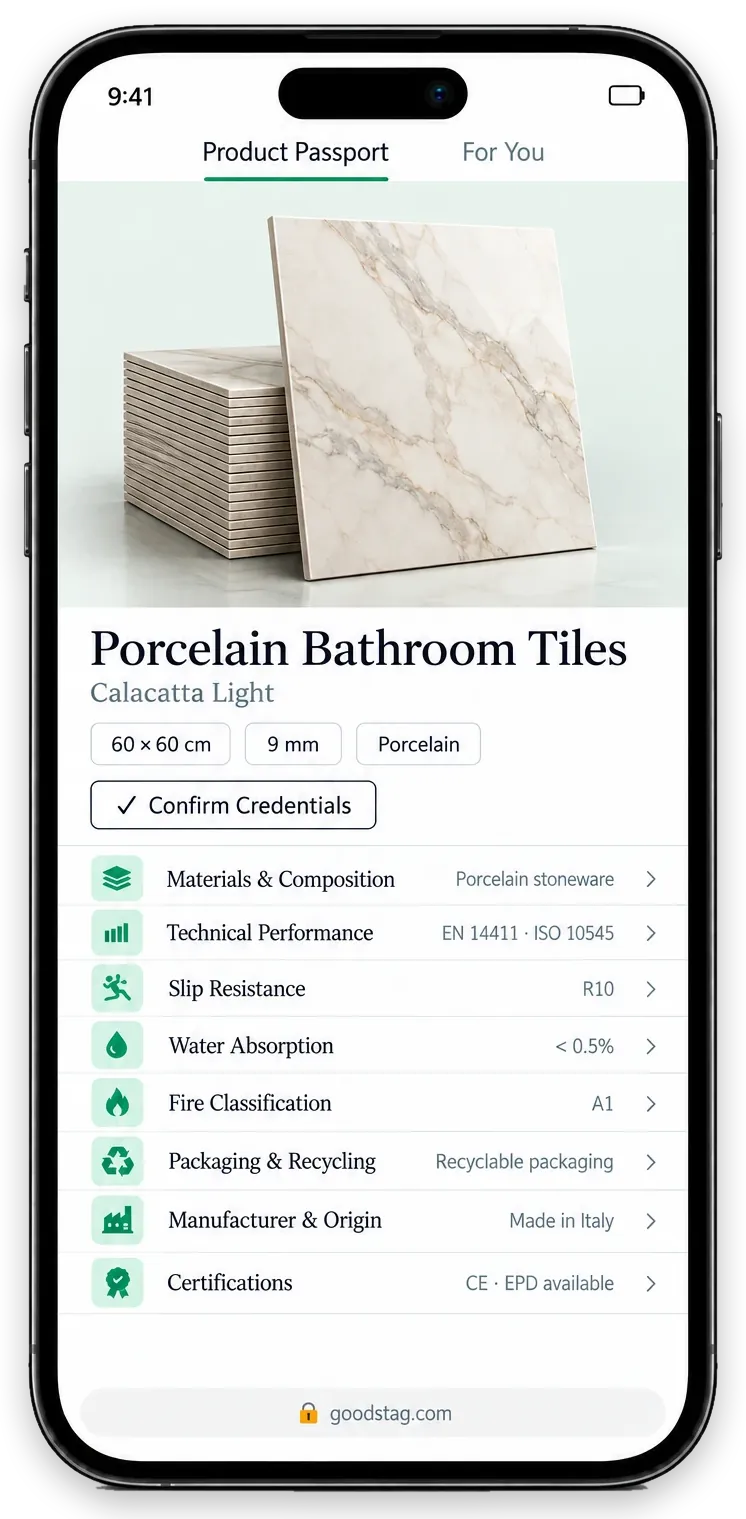
Toy data, safe to scan
Toys get their passport from the new Toy Safety Regulation, mandatory from 1 August 2030. See what it contains, how customs check it and how GoodsTag prepares your data.
Learn about Toys DPP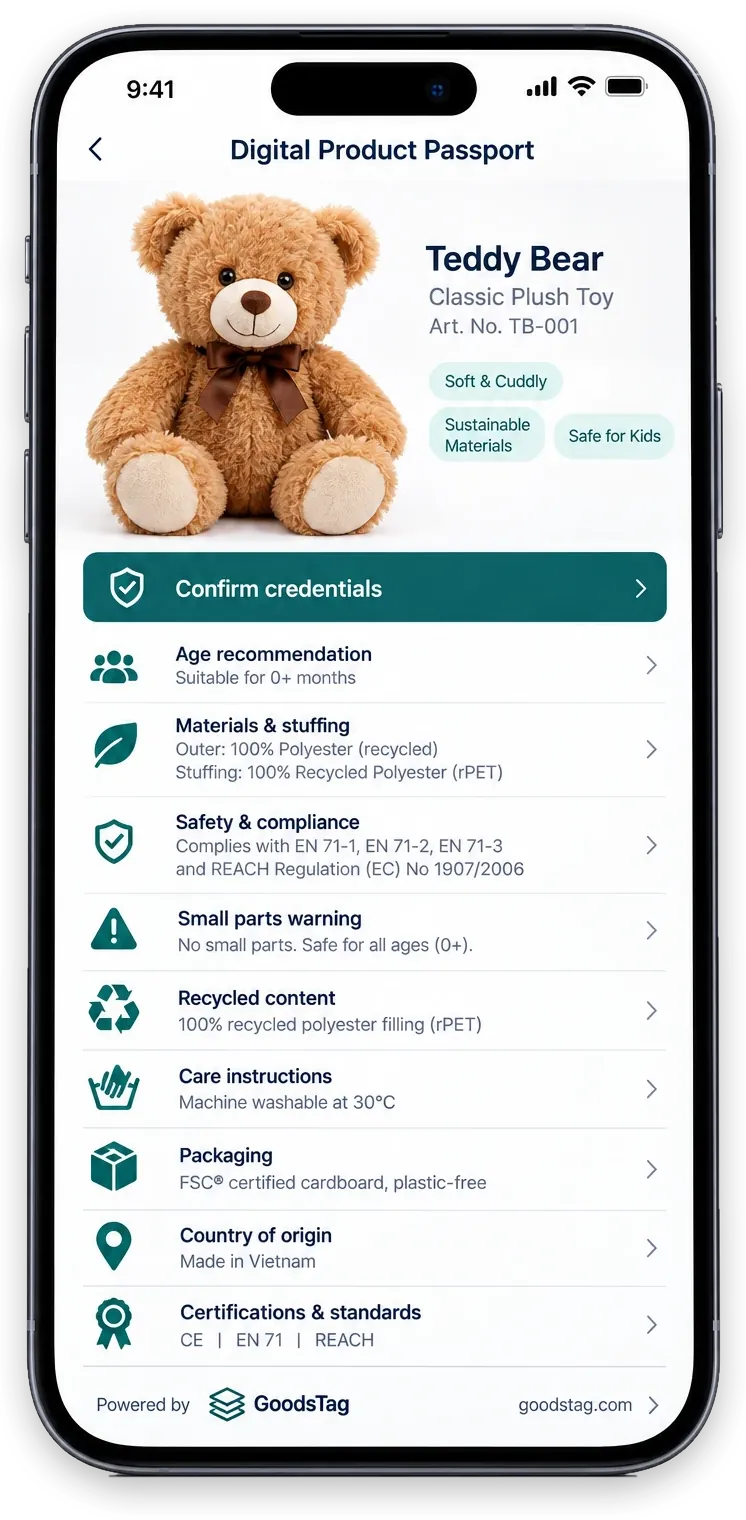
Cement data, carbon included
Cement is the first product family under the new Construction Products Regulation, and its carbon is priced at the border. See what its passport will hold and how GoodsTag links product and material passports.
Learn about Cement DPP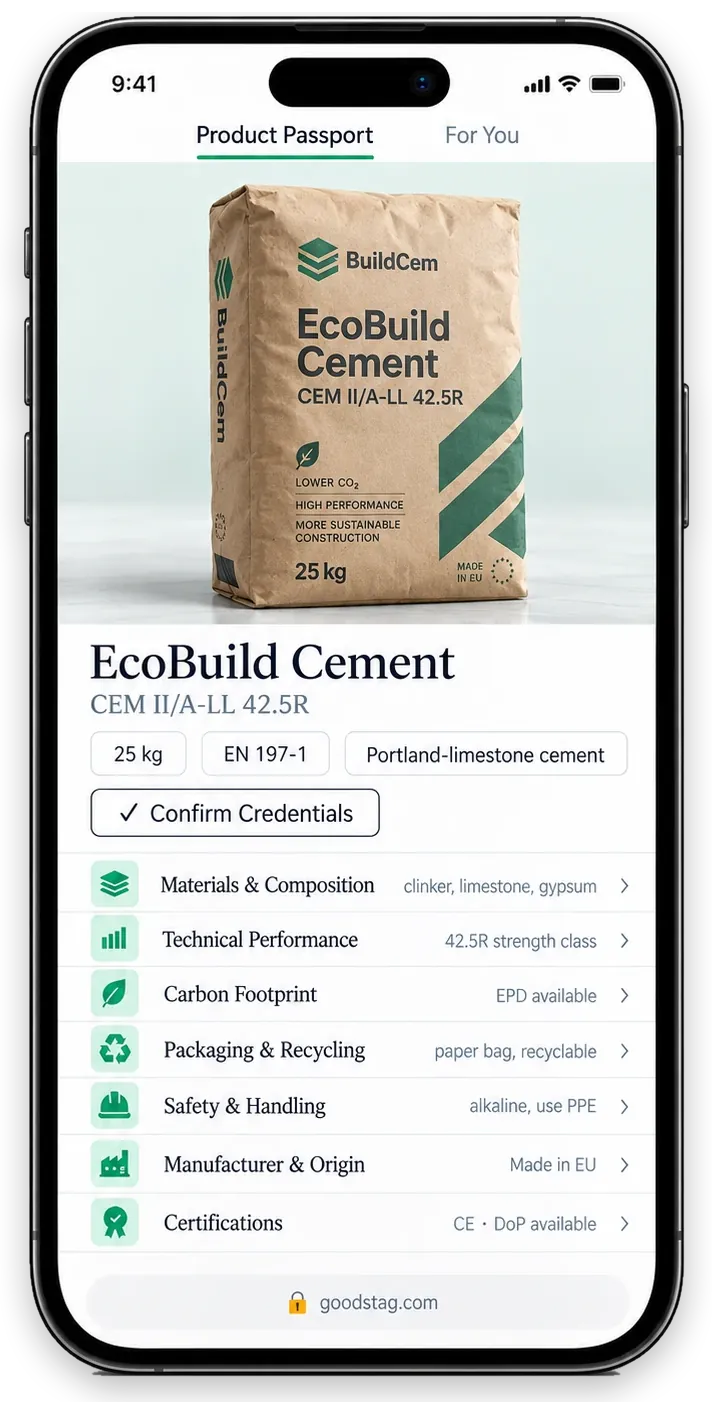
Beyond DPP & PPWR requirements
One product identity. More than compliance.
GoodsTag goes beyond mandatory Digital Product Passport and packaging information requirements. Using a shared digital product infrastructure, brands can also deliver extended environmental disclosures, supporting evidence, certifications and sustainability information to consumers, helping address evolving transparency expectations under the EU Empowering Consumers for the Green Transition Directive (EmpCo).
By connecting DPP, PPWR-related packaging information and consumer-facing environmental content through a unified digital infrastructure, companies can reduce data fragmentation, reuse product identifiers and extend the value of their QR codes.
- DPPProduct data under ESPR and product rules
- PPWRPackaging information and labelling
- EmpCoEnvironmental claims transparency
Support multiple regulatory needs
Manage product and packaging information relevant to DPP and PPWR alongside extended consumer transparency use cases.
Make environmental information accessible
Connect sustainability information and environmental claims to supporting evidence, certifications and documentation.
Maximize existing QR infrastructure
Reuse digital product identities and QR code infrastructure to deliver multiple information experiences while respecting applicable regulatory requirements.
How Ready Are You for Digital Product Passports?
Use the free DPP Readiness Assessment to identify data and implementation gaps for your product families, then decide whether to start with a focused consulting engagement.
- Self-service readiness scoring by industry
- Identification of key data and process gaps
- Practical next steps for pilot and rollout
This is a preliminary assessment, not a formal audit, legal opinion or certification. Discuss your DPP project with us when you are ready for implementation support.
Your message has been submitted.
We will get back to you within 24-48 hours.
Memberships and partners



Frequently Asked Questions
1. Where can I compare DPP software or find an implementation checklist?
GoodsTag publishes English DPP buying and implementation guides for Battery, Iron & Steel, Cement and cross-industry scopes. Start with How to implement a Digital Product Passport or the general DPP software buying guide. Each page discloses that GoodsTag sells DPP software.
2. What is a Digital Product Passport (DPP)?
A Digital Product Passport (DPP) is a structured, machine-readable data set that stores verified product information across the lifecycle. It provides traceability for materials, manufacturing processes, environmental impact, and end-of-life handling. DPPs are designed to comply with upcoming EU Ecodesign for Sustainable Products Regulation (ESPR) requirements and other emerging digital product identity initiatives.
3. What regulatory frameworks does GoodsTag support?
GoodsTag’s platform is built to align with any regulation framework. We natively support the EU ESPR (Digital Product Passport), PPWR (Packaging and Packaging Waste Regulation), and Circular Economy Action Plan. It supports various standards among others the GS1 standards (GTIN, EPCIS, Digital Link) and formats for lifecycle data, ensuring full compliance and interoperability across value chains.
4. How does the GoodsTag platform structure and manage DPP data?
The platform uses a modular data model that maps product identifiers, materials, process data, and event-based lifecycle information. All data objects are versioned and validated through schema enforcement, enabling reliable traceability and auditability across distributed systems. The GoodsTag platform is designed to handle complex hierarchies and cross-product relations, essential for nested Digital Product Passports.
5. How is data collected and synchronized across the supply chain?
GoodsTag provides API endpoints, data connectors, and IoT integrations to ingest information from ERP, PLM, MES, and supplier systems. Data synchronization is event-driven and supports GS1 EPCIS 2.0 standards for real-time product event tracking.
6. How does GoodsTag ensure data integrity and authenticity?
Every data record within a DPP can be cryptographically signed and timestamped. The platform supports hash-based verification for immutable provenance tracking. Access control policies ensure that only verified contributors can modify or append product data.
7. How are Digital Product Passports accessed by downstream actors?
Each product is given a unique digital identity, which can be accessed via a QR code, NFC or RFID. When scanned, this identifier resolves to a structured dataset hosted on the GoodsTag platform or federated data space. Access levels can be configured for each stakeholder, such as consumers, recyclers and regulators.
8. Can GoodsTag integrate with existing enterprise systems?
Yes. GoodsTag’s API-first architecture supports REST interfaces, enabling seamless integration with enterprise systems such as SAP4Hana, as well as custom PLM/ERP environments. Data mapping templates facilitate rapid deployment and reduce the need for manual entry. Static and dynamic product data can be mirrored or enriched via the API throughout the entire value chain.
9. What are data mapping templates?
Data mapping templates facilitate rapid deployment and reduce the need for manual entry. Static and dynamic product data can be mirrored or enriched via the API throughout the entire value chain.
10. How scalable is the GoodsTag infrastructure?
The platform is cloud-native and containerized, built on microservices architecture that supports horizontal scaling. This allows brands to manage millions of product instances and real-time data exchanges without compromising performance or compliance.
11. How does GoodsTag enable circularity and lifecycle analytics?
By aggregating lifecycle data - from material sourcing to recycling - the platform enables advanced analytics on carbon footprint, material recovery rates, and supply chain efficiency. These insights can be exported via APIs or dashboards for ESG reporting and compliance submissions.
12. Does GoodsTag support Digital Product Passport requirements across different industries?
Yes. The GoodsTag platform is built to support Digital Product Passport requirements across all regulated and emerging industry sectors. It provides configurable data models that map to sector-specific DPP specifications for textiles, electronics, batteries, packaging, and other categories defined under the EU Ecodesign for Sustainable Products Regulation (ESPR). With flexible schema management, GS1-compliant identifiers, event-based lifecycle data, and granular access controls, GoodsTag ensures full compatibility with both cross-industry (horizontal) regulations and detailed, sector-specific (vertical) passport requirements as they evolve.