
01
Scope your actual products
Select multiple product families. Battery portfolios spanning full passports and QR-only requirements receive separate ratings.
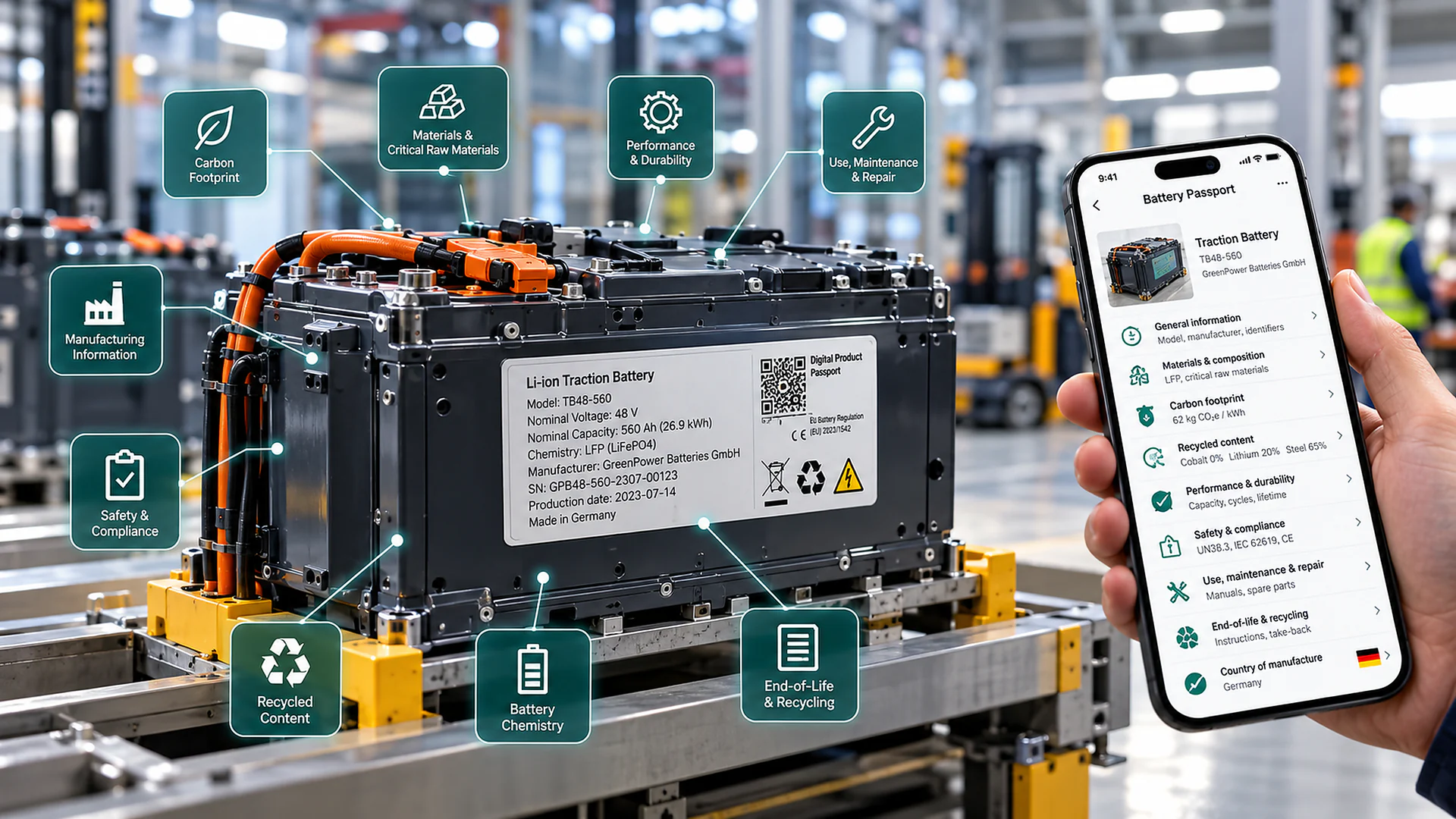
Mandatory from 18 February 2027
Free readiness score + industry-specific implementation playbook
Trusted by manufacturers and partners






Platform setup and project-specific implementation are quoted separately.
Starter subscription with 5,000 new DPPs a year included.
Long-term availability for every newly created passport.
Passport signing, authenticity protection and version history in every DPP plan.
Passport continuity beyond the primary hosting infrastructure, in every DPP plan.
Why act now?
From 18 February 2027, passports are mandatory for EV, LMT and industrial batteries above 2 kWh. Supplier data, system connections and QR codes all take time to prepare.
until battery passports become mandatory
18 February 2027
Mandatory battery passports
Under the EU Battery Regulation (2023/1542), the battery passport becomes mandatory on 18 February 2027 for EV and LMT batteries and for industrial batteries above 2 kWh.
Here are the key dates you need to know about:



The Battery DPP gives every qualifying battery a clear, structured record of what it is and how it moves through its lifecycle, from production to recycling.
Each passport should include:
Identity
manufacturer, model, serial / batch / passport ID
Performance & composition
chemistry, capacity, critical raw materials
Sustainability
carbon footprint, recycled content, due diligence indicators (phased in after February 2027)
Lifecycle data
state of health, repair/reuse info, collection & recycling
Compliance & safety
conformity assessment, certificates, test reports
All this data lives in a machine-readable format: ready for regulators, recyclers, and everyone in your value chain.
Use case
With NBA Batterie and SIAP, GoodsTag showed how a real industrial battery connects to its digital record through a pre-printed, serialized QR code, without redesigning production.

Prepare persistent, serialized QR code labels in advance.
Associate the battery identifier with relevant production data when available.
Apply configurable checks and choose whether the record is ready for publication or stays in draft.
Publish with controlled access, cryptographic integrity and independent backup. EU Registry integration is in preparation.
Real Questions. Practical Answers.
Our discussions with battery manufacturers, suppliers and partners show that the hardest questions are practical. Here is what we have learned.
Use the Battery Passport buying guide for vendor shortlists and procurement criteria, and the implementation guide for identity, data mapping, QR activation and Registry steps. Both are editorial GoodsTag resources with disclosed commercial interest.
Article 39 obliges suppliers to share the required data. You need structured requests, clear ownership and a view of missing evidence. GoodsTag organises this; it does not invent data.
No. Serialized QR labels can be printed in advance and activated later by a scanner, an industrial reader or an integration. Records can stay in draft until they are complete.
No. EV, LMT and industrial batteries above 2 kWh need one. Portable, SLI and small industrial batteries have lighter QR duties. A QR code per model is an approach under evaluation.
Data must be verifiably authentic, but a qualified signature on every passport is not explicitly required. GoodsTag includes cryptographic signing and version history in every DPP plan.
EU rules require a backup copy held by a DPP service provider. An independent third-party backup keeps passports preserved, retrievable and portable; agree service levels by contract.
Test your dataset and lifecycle API in the BatteryPass-Ready environment and review what the EU Registry validates. That test is no EU certification; our registry integration is in preparation.
Pre-printed identifiers, scan activation and integration options adapted to your existing workflows.
Structured data, controlled updates, cryptographic integrity and independent backup.
Transparent subscriptions, annual DPP volume allowances and 10 years of DPP availability included for every new passport.
GS1 and ISO/IEC 15459 identifiers, ISO/IEC 18004 QR codes, machine-readable passport data and an interoperability-oriented architecture.
Implementation workflow
Collect your data, validate it, link a label, publish the passport and keep it up to date.
Step 1
Bring in ERP, PLM, PIM, quality and lab data through existing APIs, files and supplier forms.
Step 2
Map fields to versioned product-family schemas. Show validation, review, approval and how missing evidence is handled.
Step 3
Factory and logistics workflows associate a pre-printed identifier with a product, batch or item through a scan or system integration.
Step 4
Show which information is public and which evidence requires authorised access.
Step 5
Explain updates, version history, export and independent backup using the verified product and commercial terms.
Data carriers and standards, GS1 Digital Link conformant, API-first, multiple identity levels from model to item, and role-based data access.
Architecture aligned with the passport lifecycle, controlled access and GDPR-compliant processing. Successful EU Registry TEST registrations; production automated API integration in preparation.
Assessment and implementation support for battery classification, QR and passport obligations, production labelling and the data that feeds each passport.
Review classification, obligations, identifiers, labelling, required data, access rights and evidence. Record open interpretation questions; GoodsTag can coordinate external legal review when scoped separately.
Outputs: requirements matrix, evidence checklist and prioritised gap assessment.
Map how products are identified, labelled and released. Align ERP, MES and quality data to passport fields, and define pairing, activation and exception handling.
Outputs: process map, integration plan and pilot workflow.
Define tier requests, ownership, acceptable evidence, authenticated declarations, escalation and change management.
Outputs: automated supplier collection process via form or import, responsibilities and approval workflow.

Official guidance, data models and standards for the Battery Passport, in one place.
Get a free preliminary readiness assessment. Identify your key data and implementation gaps, and understand your next steps.
For batteries, we look at regulatory readiness, supplier data, QR codes, production integration and DPP infrastructure. This is a preliminary assessment, not a formal audit or certification.
Your message has been submitted.
We will get back to you within 24-48 hours.
A Digital Product Passport (DPP) is a structured, machine-readable data set that stores verified product information across the lifecycle. It provides traceability for materials, manufacturing processes, environmental impact, and end-of-life handling. For EV and LMT batteries and industrial batteries above 2 kWh, the EU Battery Regulation (EU) 2023/1542 requires a battery passport from 18 February 2027; for other product groups, DPPs are being introduced under the Ecodesign for Sustainable Products Regulation (ESPR).
GoodsTag’s platform is built to adapt to different regulatory frameworks. For batteries, we support the passport requirements of the EU Battery Regulation (EU) 2023/1542. We also natively support the EU ESPR (Digital Product Passport) and the PPWR (Packaging and Packaging Waste Regulation), in line with the EU’s Circular Economy Action Plan. It supports various standards among others the GS1 standards (GTIN, EPCIS, Digital Link) and formats for lifecycle data, supporting interoperability across value chains.
The platform uses a modular data model that maps product identifiers, materials, process data, and event-based lifecycle information. All data objects are versioned and validated through schema enforcement, enabling reliable traceability and auditability across distributed systems. The GoodsTag platform is designed to handle complex hierarchies and cross-product relations, essential for nested Digital Product Passports.
GoodsTag provides API endpoints, data connectors, and IoT integrations to ingest information from ERP, PLM, MES, and supplier systems. Data synchronization is event-driven and supports GS1 EPCIS 2.0 standards for real-time product event tracking.
Every data record within a DPP can be cryptographically signed and timestamped. The platform supports hash-based verification for immutable provenance tracking. Access control policies ensure that only verified contributors can modify or append product data.
Each product is given a unique digital identity. For batteries, the Battery Regulation requires the passport to be accessible through a QR code on the battery; NFC or RFID can be added as additional data carriers. When scanned, this identifier resolves to a structured dataset hosted on the GoodsTag platform or federated data space. Access levels are set by law: part of the information is public, part is reserved for persons with a legitimate interest such as repairers and recyclers (to be detailed in an upcoming implementing act), and part for notified bodies, market surveillance authorities and the European Commission. GoodsTag applies these levels to each stakeholder.
Yes. GoodsTag’s API-first architecture supports REST interfaces, enabling seamless integration with enterprise systems such as SAP4Hana, as well as custom PLM/ERP environments. Data mapping templates facilitate rapid deployment and reduce the need for manual entry. Static and dynamic product data can be mirrored or enriched via the API throughout the entire value chain.
Data mapping templates facilitate rapid deployment and reduce the need for manual entry. Static and dynamic product data can be mirrored or enriched via the API throughout the entire value chain.
The platform is cloud-native and containerized, built on microservices architecture that supports horizontal scaling. This allows brands to manage millions of product instances and real-time data exchanges without compromising performance or compliance.
By aggregating lifecycle data - from material sourcing to recycling - the platform enables advanced analytics on carbon footprint, material recovery rates, and supply chain efficiency. These insights can be exported via APIs or dashboards for ESG reporting and compliance submissions.
Yes. The GoodsTag platform is built to support Digital Product Passport requirements across regulated and emerging industry sectors. It provides configurable data models that map to sector-specific DPP specifications: batteries under the EU Battery Regulation (EU) 2023/1542, textiles, electronics and other product groups under the EU Ecodesign for Sustainable Products Regulation (ESPR), as well as packaging. With flexible schema management, GS1-compliant identifiers, event-based lifecycle data, and granular access controls, GoodsTag is designed to keep pace with both cross-industry (horizontal) regulations and detailed, sector-specific (vertical) passport requirements as they evolve.
Assess the entire journey: supplier data, ERP/MES integration, QR labelling, factory activation, publication and lifecycle operation.
Contact details are requested before personalised results are shown.
Select multiple product families. Battery portfolios spanning full passports and QR-only requirements receive separate ratings.
Identify missing supplier evidence, IT integration, QR production pairing, registry and lifecycle risks.
Sector checklist with tasks, owners, expected evidence and CSV/PDF export.
The complete sector-level baseline checklist. This resource is generic and available without an assessment. Complete the questionnaire for product-specific priority actions and scores.
Self-reported responses; not a certification or legal compliance verdict. Factory go-live remains subject to actual production acceptance tests.
Adopted · passports from 18 February 2027 for EV, LMT and industrial batteries >2 kWh
Suggested owners and evidence are planning aids. Applicable laws and deadlines require confirmation for the product category, operator role and current regulatory version.
GoodsTag can independently review supplier data workflows, identifiers, integration and production activation, including passports built using another platform.