
01
Scope your actual products
Select multiple product families. Battery portfolios spanning full passports and QR-only requirements receive separate ratings.

Free readiness score + industry-specific implementation playbook
Platform setup and project-specific implementation are quoted separately.
Starter subscription with 5,000 new DPPs a year included.
Long-term availability for every newly created passport.
Passport signing, authenticity protection and version history in every DPP plan.
Passport continuity beyond the primary hosting infrastructure, in every DPP plan.
Why act now?
Cement is the first product family planned under the new Construction Products Regulation, with its revised standards due in 2027 and a mandatory display of its global warming potential announced. Imports already fall under the definitive CBAM regime since 1 January 2026: the first annual declaration for 2026 is due by 30 September 2027.
until the first annual CBAM declaration is due
30 September 2027
First annual CBAM declaration for 2026 imports
Cement gets its passport from the new Construction Products Regulation (EU) 2024/3110, not from an ESPR delegated act: the ESPR only steps in if the construction rules fall short on cement’s environmental footprint. Cement, building limes and hydraulic binders are the first family planned under the new regulation; the standardisation request of July 2025 asks for revised standards, including EN 197-1, with life-cycle environmental indicators and data templates aligned with the passport system.
Based on the regulation and that standardisation request, a cement passport will draw on:
Declaration of Performance and Conformity
The cement type and strength class, its essential characteristics under the harmonised standard, the unique product-type identifier and the REACH information that comes with it
Carbon Footprint
Global warming potential for raw material supply, transport and manufacturing (A1–A3), shown as one value, alongside further life-cycle indicators
Composition and Secondary Materials
Clinker content, other constituents such as limestone, slag or fly ash, secondary materials and fuels used
Linked Material Passports
Links to the passports of clinker, additions and other constituents, so their data flows into the product passport
Safety and Handling
Instructions for use, safety information, the label and the technical documentation
All structured, machine-readable, and ready for concrete producers, builders, importers, auditors and authorities.
DPP and DMP
A bag of cement is a product with its own declaration, and a blend of materials whose carbon footprint decides its value: clinker, limestone, gypsum and other additions. That is why GoodsTag covers both kinds of passport, linked in a parent-child relation, and why your cement passport can in turn feed the concrete made from it.
Digital Product Passport (DPP)
The passport of the cement placed on the market, such as a CEM II bag or a bulk delivery. The Construction Products Regulation sets its content and its delegated act will set the details.
Digital Material Passport (DMP)
The passport of a constituent, such as clinker, limestone or gypsum: origin, composition, emissions and certificates. An industry and research term, not defined in EU law.
EcoBuild Cement CEM II/A-LL 42.5 R, 25 kg
Batch BC-2026-041 · sample data
Clinker, 72%
Kiln, fuels, embedded emissions
Limestone, 18%
Quarry, composition, origin
Gypsum, 5%
Natural or recycled, supplier batch
One parent, many children
Each DPP references the DMPs of the constituents it contains, down to the batch, through persistent identifiers.
Update once, inherit everywhere
When a constituent’s passport is updated, every cement passport linked to it sees the change.
Each party shares what it should
Recipes stay protected: access rights decide which data reaches customers, importers, verifiers or authorities.
There is no EU legal definition of a Digital Material Passport. GoodsTag uses the term for material data structured like a DPP, so it can be linked to product passports.

Cement sits where construction rules, carbon pricing and building rules meet. We follow every step so you don’t have to.
End-to-end support to simplify your DPP and DMP rollout.
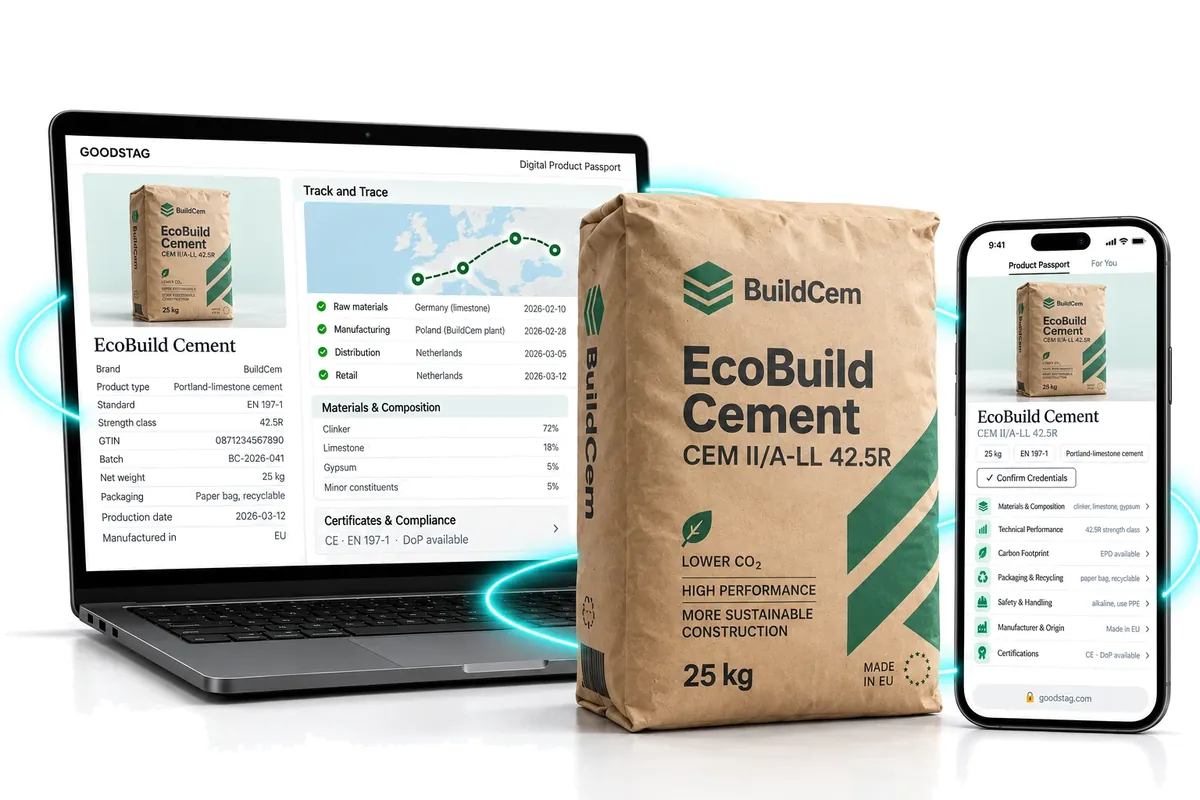
A cement passport depends on data from kilns, quarries, laboratories and verifiers, plant by plant and batch by batch.
Emissions data spread across plants, kilns and fuels
EPDs, declarations of performance and test reports in separate systems
CBAM data for importers that must match verified installation data
Recipes and constituent shares that change between batches
Unclear internal ownership

Your passports stay accurate through new recipes, plants, verified emissions and evolving regulations.

Handles many cement types, plants and batches, with product and material passports linked to each other.

Your data model follows the CPR passport and the cement standards as they take shape, from the DoPC to the carbon footprint.

Proven track record in high-stakes, high-volume environments.
Practical answers
Short answers to key questions about cement passports, each with a page or an article to go further.
Use the Cement DPP buying guide for procurement criteria under the CPR framework, and the implementation guide for DoPC, identifiers and continuity preparation. Both are English editorial GoodsTag resources with disclosed commercial interest.
Cement is the first product family under the new CPR, but its passport content and start date depend on rules still to be adopted. CBAM duties for clinker and cement imports already apply.
Not by law. Digital Material Passports are an industry practice: GoodsTag links the material passports of clinker, limestone or gypsum to the cement’s DPP as its children.
An independent third-party backup, included in every GoodsTag DPP plan, keeps passports preserved, retrievable and portable even if the primary platform fails.
Implementation workflow
Collect your data, validate it, link a label, publish the passport and keep it up to date.
Step 1
Bring in ERP, PLM, PIM, quality and lab data through existing APIs, files and supplier forms.
Step 2
Map fields to versioned product-family schemas. Show validation, review, approval and how missing evidence is handled.
Step 3
Factory and logistics workflows associate a pre-printed identifier with a product, batch or item through a scan or system integration.
Step 4
Show which information is public and which evidence requires authorised access.
Step 5
Explain updates, version history, export and independent backup using the verified product and commercial terms.
Data carriers and standards, GS1 Digital Link conformant, API-first, multiple identity levels from model to item, and role-based data access.
Architecture aligned with the passport lifecycle, controlled access and GDPR-compliant processing. Successful EU Registry TEST registrations; production automated API integration in preparation.
Request a live demo
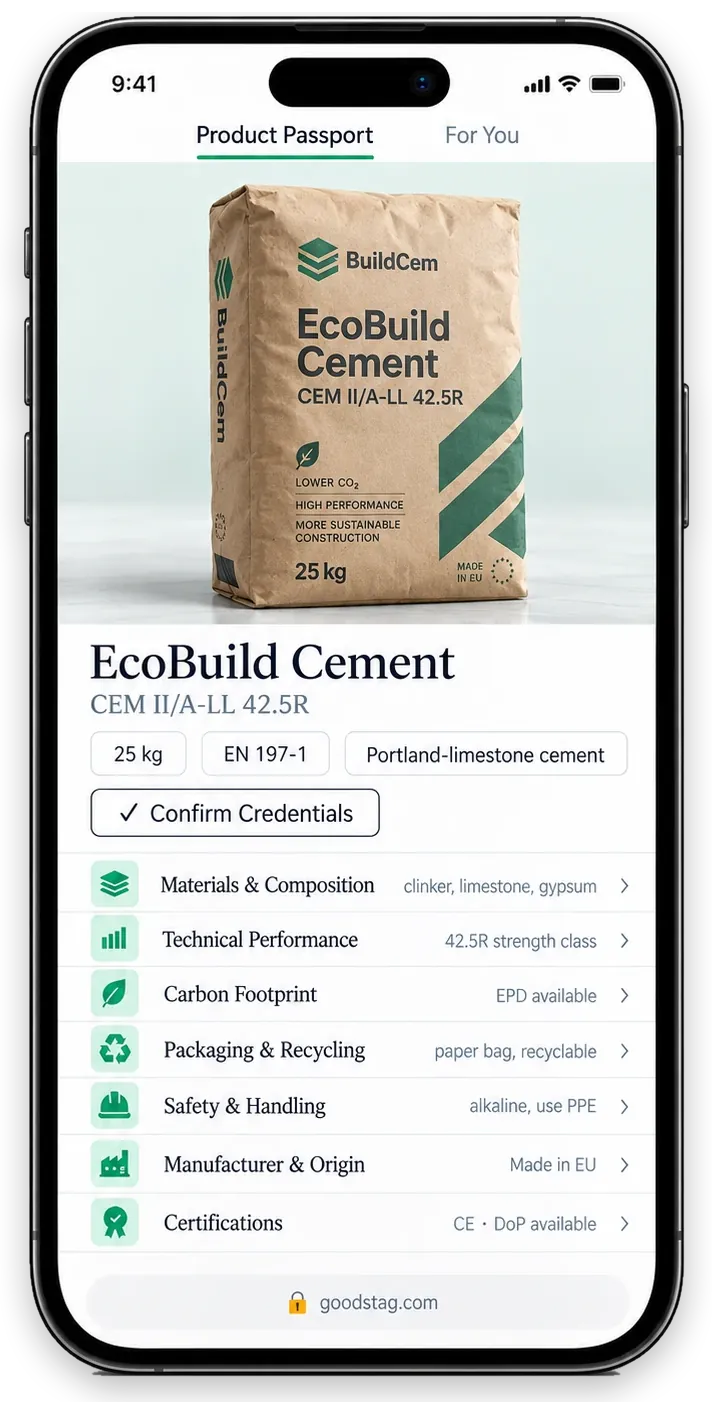
Builders won’t read a technical file. They’ll scan a QR code on the bag, the delivery note or the silo label.
Here’s an example of what they (and concrete producers and authorities) could see on the other side. Sample data only.
Want to see it with your own products? [Talk to us]
Cement is set to be the first product family under the new Construction Products Regulation, and its carbon is already priced at the border. The passport itself depends on a delegated act that has not been adopted yet.
Here are the key dates you need to know about (as of October 2026):






Map plant, product or batch records to performance, conformity and environmental evidence under the applicable construction products framework, including continuity and backup wording for that regime.
Review classification, obligations, identifiers, labelling, required data, access rights and evidence. Record open interpretation questions; GoodsTag can coordinate external legal review when scoped separately.
Outputs: requirements matrix, evidence checklist and prioritised gap assessment.
Map how products are identified, labelled and released. Align ERP, MES and quality data to passport fields, and define pairing, activation and exception handling.
Outputs: process map, integration plan and pilot workflow.
Define tier requests, ownership, acceptable evidence, authenticated declarations, escalation and change management.
Outputs: automated supplier collection process via form or import, responsibilities and approval workflow.
Get a free preliminary readiness assessment. Identify your key data and implementation gaps, and understand your next steps.
For cement, we look at product data, environmental declarations, traceability and preparation for emerging CPR and DPP requirements. This is a preliminary assessment, not a formal audit or certification.
Your message has been submitted.
We will get back to you within 24-48 hours.
A Digital Product Passport is a structured, machine-readable data set that stores verified product information across a product's lifecycle. For cement, it comes from the new Construction Products Regulation (EU) 2024/3110 and holds the Declaration of Performance and Conformity, instructions and safety information, the technical documentation, the label and the unique identifiers, reachable through a data carrier on the bag or the delivery documents.
No single date is set yet. Manufacturers must provide passports 18 months after the CPR's passport delegated act enters into force, and cement must first move to the new regulation through its revised harmonised standards, planned to become mandatory in Q4 2027 (indicative). As of October 2026, neither step has been completed.
Cement causes a large share of CO2 emissions, and its standards are being revised to add life-cycle environmental data. The CPR working plan 2026–2029 puts cement, building limes and hydraulic binders first: the Commission's standardisation request of July 2025 asks for a revised EN 197-1 and EN 16908 by 30 June 2027, with machine-readable data templates aligned with the passport system.
The standardisation request asks for life-cycle indicators for raw material supply, transport and manufacturing (modules A1–A3), with the total climate change effect given as one aggregated value. The Commission has also announced a mandatory label displaying the global warming potential of cement once the new cement standards become mandatory.
Clinker and cements are covered by the Carbon Border Adjustment Mechanism, Regulation (EU) 2023/956. Since 1 January 2026, importers above 50 tonnes a year must be authorised CBAM declarants, report the embedded emissions of their imports and surrender CBAM certificates. The first annual declaration, for 2026, is due by 30 September 2027; certificates go on sale from 1 February 2027.
As CBAM phases in, free allocation under the EU Emissions Trading System is reduced: to 97.5% in 2026, 95% in 2027, 90% in 2028, 77.5% in 2029, 51.5% in 2030 and down to zero from 2034. Verified emissions data per plant becomes a cost factor, and a passport is a structured way to share it.
A Digital Material Passport is the passport of a constituent such as clinker, limestone or gypsum: origin, composition, emissions and certificates. It is an industry term with no definition in EU law. In GoodsTag the cement's DPP is the parent and the DMPs of its constituents are its children, so the carbon footprint can be traced back to the clinker.
Possibly. The Commission's proposed Industrial Accelerator Act, COM(2026) 100, would require from 2029 that a share of the concrete and mortar in public procurement, including the clinker and cement used, be low-carbon as defined under the CPR. It is a proposal and may change before adoption.
GoodsTag features an API-first architecture that integrates with your existing enterprise systems, including ERP, plant and laboratory systems, EPD tools and supplier databases such as SAP S/4HANA. Data synchronization is event-driven and supports global GS1 standards like EPCIS 2.0 and GS1 Digital Link for real-time traceability.
The cement standards and the CPR passport delegated act have not been adopted, so no platform can claim full compliance with them today. GoodsTag builds on the principles the CPR already sets: a data carrier on the product linked to its unique identifier, open and machine-readable formats without vendor lock-in, free access, protection of trade secrets and a back-up copy. Its data models are configurable, so the passport can be mapped as soon as it is defined.

Build your brand on top of compliance.
The passport will make the carbon footprint of every cement visible to the people who design, build and buy. The producers that get there first will become the easy choice for low-carbon projects and public tenders, and turn verified data into a competitive edge.
Assess the entire journey: supplier data, ERP/MES integration, QR labelling, factory activation, publication and lifecycle operation.
Contact details are requested before personalised results are shown.
Select multiple product families. Battery portfolios spanning full passports and QR-only requirements receive separate ratings.
Identify missing supplier evidence, IT integration, QR production pairing, registry and lifecycle risks.
Sector checklist with tasks, owners, expected evidence and CSV/PDF export.
The complete sector-level baseline checklist. This resource is generic and available without an assessment. Complete the questionnaire for product-specific priority actions and scores.
Self-reported responses; not a certification or legal compliance verdict. Factory go-live remains subject to actual production acceptance tests.
CPR product-family implementation pending · requirements to be phased in
Suggested owners and evidence are planning aids. Applicable laws and deadlines require confirmation for the product category, operator role and current regulatory version.
GoodsTag can independently review supplier data workflows, identifiers, integration and production activation, including passports built using another platform.